Cellular Signal Boosters for RVs: What They Can Do, What They Can’t, and What to Buy
Cellular signal boosters are one of the most consistently misunderstood products in the RV connectivity market. Some people swear by them. Others buy one, use it once, and conclude it was a waste of money. The difference usually comes down to understanding what a booster actually does — and what it fundamentally cannot do.
Let me give you a clear picture before you spend $300–600 on one.
What a cell booster actually does
A cellular signal booster has three components: an outside antenna, an amplifier, and an inside antenna. The outside antenna captures signal from a cell tower. The amplifier amplifies that signal. The inside antenna rebroadcasts the amplified signal inside the RV.
The key word is amplifies. A booster takes weak signal and makes it stronger. If there’s a cell tower within range but your RV’s metal shell is attenuating the signal, or if you’re in a slight valley or surrounded by trees that weaken the signal before it reaches you, a booster can meaningfully improve your connection. You go from one bar (barely usable) to three bars (usable), or from three bars to strong signal.
What a booster cannot do: create signal where none exists. If you’re in a dead zone with no cell tower in range at all, there is no signal to amplify. A more sensitive outside antenna and a more powerful amplifier won’t conjure a connection from empty air. The boosted connection can only be as strong as what the outside antenna can find.
This is where people get disappointed. They park in a remote area with no cell signal, install a booster, and get no cell signal. The booster worked exactly as designed — there was nothing to amplify.
When a booster is worth it
Boosters deliver real value in specific situations:
Weak signal that’s present but marginal. If you have one or two bars of signal that keeps dropping and barely functions, a booster can push that to a reliable three or four bars. This is the ideal use case.
Metal RV attenuation. RV walls — especially aluminum-sided coaches — block cellular signal significantly. A booster compensates for the signal loss caused by the vehicle itself. Your phone outside the RV might show three bars while inside it shows one; a booster can restore what the metal shell is taking away.
Edge-of-coverage areas. Near the edge of a carrier’s coverage map, a booster’s directional outside antenna can pick up towers that your phone’s built-in antenna would miss.
Fringe campground scenarios. A campground that’s close enough to civilization to have cell coverage, but where that coverage is inconsistent, is exactly where a booster earns its cost.
When it’s not the right solution
True dead zones. No booster changes this. If the coverage maps show no signal, don’t buy a booster. Buy Starlink.
Poor data speeds on a strong signal. Cellular slowdowns in areas with strong signal are usually a tower congestion problem — too many users, too little capacity. A booster amplifies signal strength, not tower capacity. You can’t boost your way out of a congested tower.
When the limiting factor is your data plan. If you’re being speed-throttled because you’ve hit your data cap, signal strength is irrelevant.
What to buy
weBoost (now owned by Wilson Electronics) is the most established brand in the RV booster market. Their Drive Reach RV is designed specifically for RVs, with an outdoor antenna suitable for roof mounting, a 65 dB gain amplifier, and indoor antennas for the living space. Street price is typically $450–550. It’s compatible with all US carriers simultaneously (one booster, all carriers).
Cel-Fi Go products, particularly the Cel-Fi Go X from Nextivity, offer some of the highest legal gain available (100 dB, vs. the 65 dB FCC limit for multi-carrier boosters) but are carrier-specific — you need a separate unit per carrier. More complex, more expensive, but potentially more effective in specific situations.
Budget options from SureCall and similar brands are available in the $150–300 range. They work on the same principle, with lower amplification and generally less robust outdoor antennas. Worth considering for occasional use; for full-time RVers, the weBoost lineup is a better long-term investment.
Installation notes
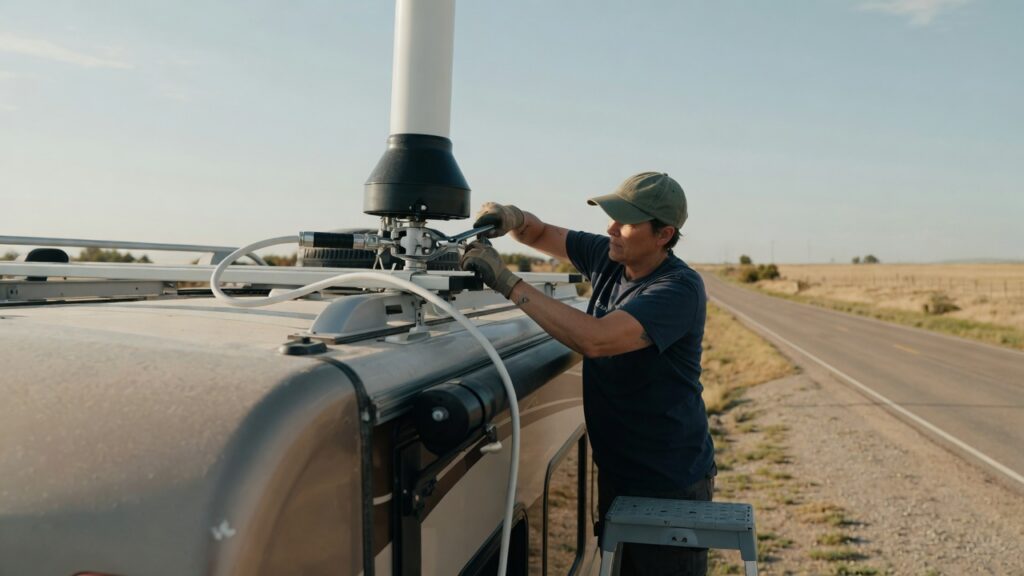
For an RV, you’ll want an outside antenna that can be mounted to the roof or raised on a pole when you’re parked. A fixed roof mount is simpler and always in position; a pole mount gives you the ability to raise the antenna higher than the roofline, which can make a meaningful difference in signal pickup. The inside antenna is usually placed centrally in the living area.
Keep the inside and outside antennas at least 20–30 feet apart (or on opposite ends of the RV) to avoid oscillation — where the amplifier amplifies its own output and creates feedback.
The bottom line
A cellular signal booster is a useful tool for a specific problem: improving weak-but-present cellular signal. If that’s your situation, it works well. If you’re looking for a solution to no signal in remote areas, save the money and invest in a Starlink subscription instead. The two tools solve different problems, and matching the right one to your actual connectivity situation is how you avoid buyer’s remorse on the road.

Connor writes practical guides on Wi-Fi, mesh networks, and home security — breaking down complex IT topics into clear, beginner-friendly steps.
More about me →